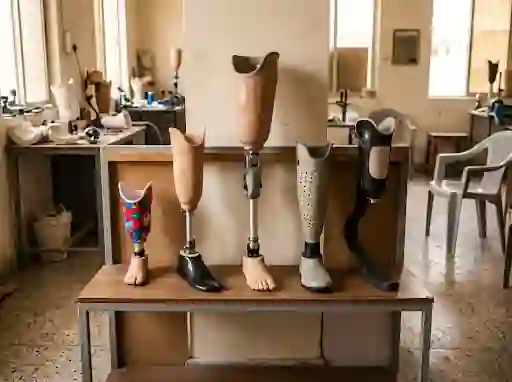
Below Knee Artificial Leg
The most common leg we fit: your own knee bends, the socket and foot do the rest.
Read more31 legs, parts and services
Start with the level of amputation, then look at the person, the parts and the care that keeps a leg working. Every page explains who it suits, what it costs and how many visits it takes, and every leg begins with a free assessment.
How to use this page
The short answer
Find your amputation level first; it shapes everything else. Then look at the pages for the person (a child, an elderly parent, after diabetic surgery), the knee and foot you are considering, and the socket and suspension. If your leg already exists and is giving trouble, the care pages cover sockets, repairs and alignment.
Every leg is made and fitted at our Karachi clinic, and every one starts with a free assessment and ends with walking training.
By amputation level
The level of the amputation is the first thing that shapes a leg. It decides the socket design, whether there is a knee to replace, and most of the price. Below knee legs are the most common and the simplest to walk on; above knee and hip level legs need more training and a careful choice of knee. If both legs are affected, the two legs are planned and aligned together as a pair.
The most common leg we fit: your own knee bends, the socket and foot do the rest.
Read moreReplaces the knee too. The knee joint you choose shapes how you walk.
Read moreFor amputation through the knee: an end-bearing stump and a compact knee.
Read moreA pelvic socket with hip, knee and foot, for the highest level of amputation.
Read moreToe fillers, insoles and silicone partial feet that protect what remains.
Read moreA short, strong leg for an ankle amputation with a healthy heel pad.
Read moreTwo legs planned together, with extra care for balance and training.
Read morePlanned around the person
Two people with the same amputation can need very different legs. A growing child needs a leg that can be lengthened and changed often; an elderly parent needs safety and ease above all; a stump after diabetic surgery needs a softer socket and closer skin checks; and someone only weeks after surgery may do best with a temporary leg first.
Legs that grow with your child, with regular checks and quick changes.
Read moreLight, safe legs for standing, transfers and walking at home.
Read moreSofter sockets and closer skin checks for a stump that heals slowly.
Read moreAn early, simple leg to get you standing while the stump settles.
Read moreKnees and feet
Knees and feet are where prices spread from tens of thousands to millions of rupees. We fit what your walking actually needs: a locking knee for safety, a polycentric knee for stability, a hydraulic or microprocessor knee for active users; and a SACH, multiaxial or carbon fibre foot depending on where and how far you walk.
Sensor-controlled knees for active above knee users who walk a lot.
Read moreSmooth, speed-adapting knees for daily outdoor walking.
Read moreFour-bar knees: stable when standing, short when swinging.
Read moreKnees that stay straight until you unlock them to sit. Safest for first legs.
Read moreSpringy feet that store energy and give a stronger push-off.
Read moreSimple, tough, affordable feet with a cushioned heel.
Read moreFeet that tilt and twist to cope with uneven streets and slopes.
Read moreSockets and suspension
The socket is the part you feel all day, and most comfort problems start or end there. Every socket is cast to your stump and tried as a clear test socket first. Liners cushion the skin, and pin lock or vacuum systems decide how firmly the leg stays on. When the stump changes, a new socket can usually be fitted to your existing parts.
The part you feel all day, cast and test-fitted to your stump.
Read moreA cushioned second skin between stump and socket, for comfort and grip.
Read moreA pin on the liner clicks into the socket and holds the leg on.
Read moreA sealed socket that holds the leg on firmly with a gentle vacuum.
Read moreA new socket for an old leg when the stump has changed shape.
Read moreSpecial legs
Some needs call for a second leg or an extra part: a waterproof leg for wudu, the shower and the beach; a running blade for training and sport; and a cosmetic cover that shapes the leg to match the other one under shalwar or trousers.
A leg for the shower, wudu, the beach and wet floors.
Read moreCarbon blades for running and sport, fitted for serious training.
Read moreFoam and skin-tone covers that match your other leg under clothes.
Read moreCare
A leg is not finished on the day it is fitted. The free assessment comes first; walking training turns a leg into a walk; stump care prepares you for the first socket; and repairs and alignment checks keep the leg comfortable for years.
A free check of the stump and your goals before anything is made.
Read moreWalking lessons on the new leg, from balance to stairs.
Read moreShrinker socks, wrapping and exercises that prepare the stump.
Read moreFixing cracked sockets, worn feet, loose bolts and tired liners.
Read moreFine-tuning a leg that causes pain, a limp or a sore back.
Read moreCost in 2026
Indicative ranges from a sound local build to fully imported parts. The free assessment ends with a firm figure in writing.
Rs 10,000 to 250,000local to imported build
Rs 45,000 to 300,000local to imported build
Rs 80,000 to 900,000+open top end: imported parts
Rs 110,000 to 700,000local to imported build
Rs 150,000 to 2,500,000+open top end: imported parts
Rs 170,000 to 2,500,000+open top end: imported parts
Rs 300,000 to 3,500,000+open top end: imported parts
Full table and guides: artificial leg prices.
Questions
Start with the level of amputation, then think about how and where you walk. The free assessment settles the details: we examine the stump, check your strength and balance, and recommend a leg with a written price.
Yes. Children's legs are built to grow, with adjustable pylons and sockets made with room to grow, and checks every few months.
Yes. Most legs are modular, so a foot, a knee or a liner can be upgraded later, and a new socket can be fitted to existing parts when the stump changes.
Yes, every assessment, casting and fitting takes place at our Karachi clinic. You can start on WhatsApp with photos and the surgeon's notes, and we plan the visits around your travel dates.
Fill this in and WhatsApp opens with your message ready to send. Add a photo of the stump in the chat if you can; it tells us more than any description.
Prefer to talk? Call +92 337 841 4002 at any hour.