Simple first leg Rs 45,000 to 90,000
A laminated socket with room to grow, a sleeve and a child SACH foot. Right for toddlers learning to stand and walk.
- Free assessment
- Test socket
- Walking practice
Paediatric prosthetics
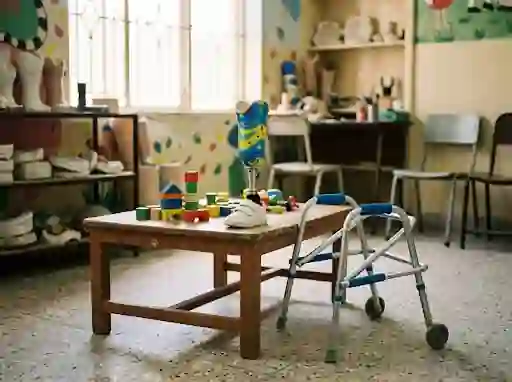
Children grow fast, play hard and adapt quickly, so a child's leg is planned around growth, not around a single fitting. We build legs that can be lengthened and adjusted, check them often, and change sockets as soon as they are outgrown.
Reviewed by Ummad Shafique Mughal, Consultant Orthotist and Prosthetist. Updated October 2026.
In short
The short answer
A child's leg uses the same parts as an adult's, scaled down: a socket, a liner or socks, a pylon and a foot, plus a knee for above knee levels. The difference is growth. Sockets are made with room to grow, pylons can be lengthened, and the leg is checked every few months so that it never holds the child back.
A child's first leg starts from Rs 45,000. Imported children's feet and knees take the price up to about Rs 300,000.
Is it right for you?
What goes into it
Every part is chosen with growth in mind.
| Part | Local build | Imported build | What it changes for you |
|---|---|---|---|
| Socket | Laminated socket with room to grow | Same, with a gel liner and a pattern the child picks | Comfort, and how long before it is outgrown |
| Suspension | Sleeve or strap | Child-size liner with pin lock | Staying on during play |
| Knee (above knee) | Locking or simple child knee | Child polycentric knee | Safety while learning, then a more natural walk |
| Foot | Child SACH foot | Child dynamic or carbon foot | Running and jumping with friends |
| Pylon | Adjustable tube | Lightweight adjustable tube | Lengthening as the child grows |
Cost in 2026
Plan for growth: most children need a new socket about once a year, and a complete new leg every few years.
Rs 45,000 to 300,000local to imported build
A laminated socket with room to grow, a sleeve and a child SACH foot. Right for toddlers learning to stand and walk.
A gel liner, a better child foot and, above the knee, a child knee. For school, play and sport.
Imported child feet and knees for very active children and teenagers.
Indicative ranges. A firm figure comes in writing after the free assessment and does not change without your agreement. Full cost guide.
Your visits
With the child and parents, at the child's own pace.
Quick and gentle; we explain each step to the child.
We watch the child walk and play in it.
Checks every three to six months to adjust for growth.
Families from other cities or from abroad: we line up follow-ups with school holidays where we can.
Children born without part of a leg are usually fitted around the age they start pulling up to stand, often near their first birthday. Starting then lets the child learn to stand and walk with the leg as part of their body, and most children accept it very quickly.
After an accident or surgery, a child is fitted once the wound has healed and the swelling has settled. Children usually heal faster than adults, so this often comes sooner than families expect.
A child's stump grows in length and changes shape. We leave room in the socket, use socks that can be removed as the child grows, and fit pylons that can be lengthened. Even so, most children need a new socket about once a year and a new leg every few years.
Watch for red marks that last after the leg comes off, a limp that comes back, the child refusing to wear the leg, or the leg looking shorter than the other one. Any of these means it is time for a check, even before the next appointment.
Children usually adapt faster than adults. Many run, climb, play cricket and football, and ride bicycles. Tell the school, so teachers know what to do if the leg rubs or comes loose during games, and keep a spare sock or liner in the school bag.
Let the child decide how to talk about the leg with friends. Some like to show it off with a bright pattern, others prefer it covered. Both are fine. Teenagers who want to run seriously can ask us about running blades.
It is natural to feel worried at first. Children follow your lead, so treat the leg as an ordinary part of life, help with putting it on, and praise effort rather than perfection. Bring the child to every check, even when the leg seems fine; small changes in fit are easy to fix early and hard to fix late. We explain everything in Urdu or English, and parents are always present.
Travelling to us?
Tell us your city or country and your travel dates when you call. We plan the visits as close together as the stump allows, so most patients can finish the casting, test socket and fitting in one stay, whether they come from Quetta or fly in from Dubai, with a shorter trip later for adjustments if needed.
Questions
Children born with a limb difference are usually fitted when they start pulling up to stand, often around their first birthday. After an accident or surgery, any age is possible once the wound has healed.
Most children need a new socket about once a year and a new leg every few years, depending on growth. Checks every three to six months catch problems early.
Yes. Many children run, jump and play cricket and football with their friends. A dynamic foot helps active children, and teenagers can move on to sport legs.
A first leg starts from Rs 45,000. Children who need imported feet or knees can reach about Rs 300,000. Because children grow, plan for socket changes over the years.
Related
The most common leg we fit: your own knee bends, the socket and foot do the rest.
Read moreCarbon blades for running and sport, fitted for serious training.
Read moreA new socket for an old leg when the stump has changed shape.
Read moreWalking lessons on the new leg, from balance to stairs.
Read moreWe import and fit parts from Ottobock, Össur, Blatchford, Proteor, Fillauer and other makers to order, and we are independent of all of them. Brands we fit.
Fill this in and WhatsApp opens with your message ready to send. Add a photo of the stump in the chat if you can; it tells us more than any description.
Prefer to talk? Call +92 337 841 4002 at any hour.