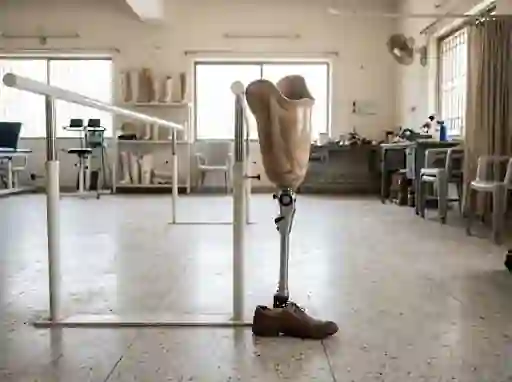
Above knee artificial leg, with the knee chosen for how you live
Above the knee, the artificial knee does the work your own knee used to do, and choosing it is the biggest decision you will make. We match the knee to your strength, balance and daily walking, then shape the socket around your thigh so you can control it.
UMReviewed by Ummad Shafique Mughal, Consultant Orthotist and Prosthetist. Updated October 2026.
In short
What is an above knee artificial leg?
The short answer
An above knee (transfemoral) leg replaces the knee, lower leg and foot after an amputation through the thigh bone. It has a socket shaped around the thigh, a way of keeping it on, a knee joint, a pylon and a foot. Walking on it takes more effort than a below knee leg because your hip muscles now control the knee, so training matters as much as the parts.
Prices start at Rs 150,000 with a mechanical knee and rise past Rs 2,500,000 with imported hydraulic and microprocessor knees.
The knee joint decides how the leg walks, sits and climbs
Is it right for you?
Who a above knee artificial leg suits
Usually a good fit if
The thigh stump has healed and the swelling has settled
You can stand on the other leg and keep your balance with support
Your hip straightens without being pulled forward
You can come for several training sessions over a few weeks
We may advise waiting, or something else, if
A very short thigh stump; a hip-style socket may be needed instead
A tight hip that will not straighten; stretching comes first
Serious heart or lung disease or very weak arms; a leg for standing and transfers, or a wheelchair, may be wiser
An open wound or a very painful nerve ending in the stump
What goes into it
The parts of an above knee leg, from simple to imported
The knee is where the price range widens most. Everything else follows from the socket.
Above knee leg: local and imported options
Part
Local build
Imported build
What it changes for you
Socket
Laminated quadrilateral or ischial containment socket
Same, with a flexible inner socket and lower trim lines
Comfort when sitting and control of the knee
Suspension
Hip belt or suction valve
Silicone liner with pin lock or vacuum seal
How firmly the leg stays on, and how it feels in the heat
Knee
Manual locking or single-axis friction knee
Polycentric, hydraulic or microprocessor knee
Safety on rough ground, speed, slopes and stairs
Foot
SACH or local dynamic foot
Carbon fibre or hydraulic ankle foot
Smoothness, push-off and distance
Rotator
Usually not fitted
Rotation adapter above the knee
Sitting cross-legged and getting into a car
Cover
None, or a sock
Foam cover shaped to the other leg
How it looks under clothes
Cost in 2026
What an above knee leg costs
Three legs can share the same socket and differ several times in price because of the knee.
Rs 150,000 to 2,500,000+open top end: imported parts
Local build Rs 150,000 to 300,000
Laminated socket with belt or suction suspension, a manual locking or single-axis knee and a SACH or local foot. Stable and safe for first legs, older users and walking at home.
Free assessment
Test socket fitting
Walking training
Mixed build Rs 300,000 to 900,000
An imported polycentric or hydraulic knee, a silicone liner and an imported dynamic foot. Smoother walking outdoors and on slopes.
Free assessment
Test socket fitting
Walking training
Fully imported Rs 900,000 to 2,500,000+
High-end hydraulic knees with vacuum suspension and premium feet. Microprocessor knees such as the Ottobock C-Leg or the Össur Rheo Knee usually cost more than this range on their own.
Free assessment
Test socket fitting
Walking training
Indicative ranges. A firm figure comes in writing after the free assessment and does not change without your agreement. Full cost guide.
Your visits
Five steps from assessment to confident walking
1
Assessment
We check the thigh, hip strength, balance and the other leg, and talk about your home and work.
2
Casting
An impression of the thigh, including the seat for the sitting bone.
3
Test socket
You stand and step in a clear socket; we check comfort, control and sitting.
4
Fitting
The knee and foot are set up and aligned while you walk between bars.
5
Training
Weight shifting, knee control, stairs, slopes and getting up from the floor, over several sessions.
Above knee legs need more training than below knee legs. Families from out of town should plan for a longer stay or a second trip.
Choosing the knee
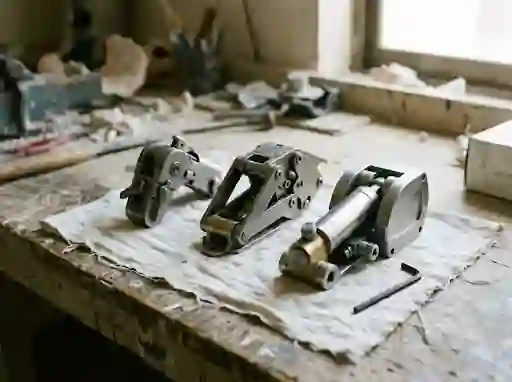
Locking knees stay straight while you walk and unlock with a lever or pull cord when you sit. They are the safest choice for first legs, older users and anyone with poor balance, but the walk is stiff. See locking knees.
Single-axis friction knees are simple and cheap. They swing freely, so you control them with your hip. Good for strong users on a tight budget.
Polycentric knees have four bars instead of one hinge. They feel very stable when you stand on them and shorten while swinging, so the toe clears the ground. A favourite for longer stumps and many older walkers. See polycentric knees.
Hydraulic knees adjust their resistance to your walking speed, so the leg keeps up whether you walk slowly through a bazaar or briskly to catch a bus. See hydraulic knees.
Microprocessor knees use sensors to control the resistance many times a second. They catch stumbles, make slopes and step-over-step stairs possible and reduce falls, but they cost a great deal, need daily charging and need servicing. See microprocessor knees.
The socket and the hip
An above knee socket has to hold the thigh firmly enough to control the knee, yet let you sit on a hard chair without pain. Older quadrilateral sockets support the sitting bone on a ledge. Ischial containment sockets wrap around it, which many users find more stable when walking. Long thigh stumps give more control; short ones need more help from the socket and suspension.
Suspension matters too. A belt is cheap and simple. Suction holds the leg without straps but can lose its seal when you sweat. A silicone liner with a pin or a seal is the most comfortable in the heat for most users.
Locking, polycentric and hydraulic knees side by side
What walking training involves
Training starts between parallel bars: shifting weight onto the leg, trusting the knee, then taking steps. Next come turning, sitting and standing, walking with a stick or crutches, and finally stairs and slopes. For stairs, the rule most people learn is "up with the good leg, down with the artificial one".
We also teach how to fall safely and how to get up from the floor, because sooner or later everybody falls once. Families are welcome to watch the sessions so they know how to help at home without over-helping.
Daily life in Pakistan with an above knee leg
Floor sitting. A rotation adapter lets you turn the lower leg aside to sit cross-legged on a dastarkhwan or at a gathering. Many users simply take the leg off for long sittings.
Toilets. Squatting toilets are hard with an above knee leg. A commode seat over the squat pan, or a western toilet, makes daily life much easier and safer.
Namaz. Most users pray standing with the leg on and use a chair for ruku and sajda. Our namaz and wudu guide explains the options.
Heat. A full thigh socket is warm. Take short breaks in summer to dry the skin and the liner, and keep a spare liner if you sweat heavily.
Energy, age and honest expectations
Walking on an above knee leg uses noticeably more energy than normal walking. Young, fit users often walk long distances without aids. Older users, especially after diabetic or vascular amputation, may use the leg mainly for standing, transfers and walking around the house, and that can still change daily life a great deal. We talk this through honestly at the assessment, and our page on legs for elderly patients explains the choices.
Travelling to us?
Coming to us for an above knee leg from another city or country
Tell us your city or country and your travel dates when you call. We plan the visits as close together as the stump allows, so most patients can finish the casting, test socket and fitting in one stay, whether they come from Quetta or fly in from Dubai, with a shorter trip later for adjustments if needed.
The best knee is the one you can control safely. First-time and older users often start with a locking or polycentric knee. Active walkers who go out every day do better with hydraulic knees, and microprocessor knees add stumble recovery and confident slopes for people who walk a lot.
What does a microprocessor knee add to an above knee leg?
It depends on the model and the exchange rate when it is imported, but on its own a microprocessor knee usually costs more than our Rs 2,500,000 upper range for a whole leg. We give the exact figure in writing after the assessment, and we will say honestly if a hydraulic knee would serve you as well.
Can I sit on the floor with an above knee leg?
Sitting on a chair is easy. For floor sitting, a rotation adapter above the knee lets you turn the lower leg aside, and many users simply take the leg off for long gatherings.
How long does it take to learn to walk on it?
Most people need several training sessions and a few weeks of daily practice to walk confidently indoors, and a few months for outdoor walking and stairs. Younger and stronger users get there sooner.
Can an elderly parent use an above knee leg?
Sometimes, yes, especially for standing, transfers and short walks at home. We assess balance, strength and heart and lung health honestly. For some a light leg with a locking knee is right; for others a good wheelchair serves better.
Light, safe legs for standing, transfers and walking at home.
Read more
We import and fit parts from Ottobock, Össur, Blatchford, Proteor, Fillauer and other makers to order, and we are independent of all of them. Brands we fit.
WhatsApp
Send us the details, get a straight answer
Fill this in and WhatsApp opens with your message ready to send. Add a photo of the stump in the chat if you can; it tells us more than any description.
Fill in what you know. Leave anything you are unsure about blank.
Send it on WhatsApp and attach a clear stump photo from the front and the side.
We reply with the options, the likely price range and the next step.