Mechanical polycentric Rs 220,000 to 400,000
Our socket, a mechanical four-bar knee and a SACH or dynamic foot. Stable and simple.
- Assessment
- Test socket
- Training
Four-bar knee
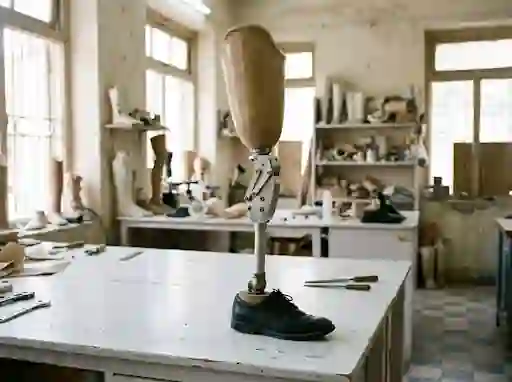
A polycentric knee turns on four linked bars instead of one hinge, so its pivot point moves as it bends. It feels very stable when you stand on it and shortens slightly as it swings, so the toe clears the ground. It suits many first legs, longer stumps and through-knee amputations.
Reviewed by Ummad Shafique Mughal, Consultant Orthotist and Prosthetist. Updated October 2026.
In short
The short answer
A polycentric knee has four bars joined at four pivots. As it bends, the point it rotates around moves, which gives two useful effects. When you stand on it straight, the knee is hard to buckle, so it feels safe. When it bends during the swing, the lower leg tucks back and the leg gets slightly shorter, so the toe does not catch. Polycentric knees come in simple mechanical versions and versions with pneumatic or hydraulic swing control, such as the Össur Total Knee and the Ottobock 3R60.
A complete above knee leg with a polycentric knee costs about Rs 220,000 to 900,000.
Is it right for you?
Versions
All share the four-bar design. What controls the swing is what changes.
| Version | Swing control | Typical user | Indicative price of the leg |
|---|---|---|---|
| Mechanical | Spring and friction | First legs, home and community walking | Rs 220,000 to 400,000 |
| Pneumatic | Air cylinder | Moderate walkers | Rs 350,000 to 650,000 |
| Hydraulic | Oil cylinder | Active walkers and through-knee users | Rs 500,000 to 900,000 |
Cost in 2026
Rs 220,000 to 900,000local to imported build
Our socket, a mechanical four-bar knee and a SACH or dynamic foot. Stable and simple.
Swing control that adapts better to your pace, with an imported dynamic foot.
Compact four-bar knees made to sit close under a full-length thigh bone.
Indicative ranges. A firm figure comes in writing after the free assessment and does not change without your agreement. Full cost guide.
Your visits
Stump length, balance and goals.
A socket shaped to give you good control of the knee.
We check stability as you stand and step.
The knee is aligned for stability, then walking practice begins.
Coming from out of town? Tell us your dates and we will plan the visits close together.
A single-axis knee bends around one hinge, so whether it buckles depends on where your weight falls in front of or behind that hinge. A polycentric knee works around an imaginary point created by its four bars, and when the knee is straight that point sits high and behind, where your weight naturally keeps the knee locked. You can feel this the first time you stand on one: it simply feels solid.
As a polycentric knee bends during the swing, the lower leg tucks back and the whole leg becomes a little shorter. The toe clears the ground more easily, which matters on broken pavements, raised door thresholds and the edges of carpets. Fewer catches mean fewer stumbles.
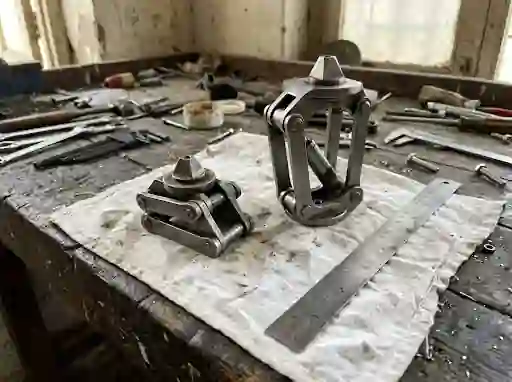
After a knee disarticulation, the full-length thigh bone leaves little room under the socket. Compact four-bar knees fold the lower leg back under the knee when you sit, keeping the knees much closer to level than an ordinary knee would.
The knee folds neatly when you sit on a chair, a car seat or a rickshaw bench. For floor sitting and namaz, many users take the leg off or use a chair for sajda. The pivots need occasional checks for wear; a new click or a loose feel is a reason to come in.
Travelling to us?
Tell us your city or country and your travel dates when you call. We plan the visits as close together as the stump allows, so most patients can finish the casting, test socket and fitting in one stay, whether they come from Quetta or fly in from Dubai, with a shorter trip later for adjustments if needed.
Questions
A single-axis knee bends around one hinge, like a door. A polycentric knee bends around a moving point created by four linked bars, which makes it more stable when standing and shorter when swinging.
Often, yes, for those with fair balance. It is more forgiving than a single-axis knee. For users with poor balance, a locking knee is safer at first.
About Rs 220,000 to 400,000 with a mechanical polycentric knee, and up to about Rs 900,000 with pneumatic or hydraulic swing control.
Yes, and it is usually the best choice, because compact four-bar knees sit close under the full-length thigh bone and keep the knees nearly level when sitting.
Related
Replaces the knee too. The knee joint you choose shapes how you walk.
Read moreFor amputation through the knee: an end-bearing stump and a compact knee.
Read moreSmooth, speed-adapting knees for daily outdoor walking.
Read moreKnees that stay straight until you unlock them to sit. Safest for first legs.
Read moreWe import and fit parts from Ottobock, Össur, Blatchford, Proteor, Fillauer and other makers to order, and we are independent of all of them. Brands we fit.
Fill this in and WhatsApp opens with your message ready to send. Add a photo of the stump in the chat if you can; it tells us more than any description.
Prefer to talk? Call +92 337 841 4002 at any hour.