Local build Rs 170,000 to 320,000
Laminated socket with a removable inner liner, a basic knee and a SACH or local foot. Solid and dependable for first legs.
- Free assessment
- Test socket fitting
- Walking training
Through-knee amputation
An amputation through the knee joint leaves the whole thigh bone, and its end can usually take weight. That gives a strong, stable stump, but it also makes the thigh long, so the knee joint and socket have to be chosen carefully to keep your knees close to level when you sit.
Reviewed by Ummad Shafique Mughal, Consultant Orthotist and Prosthetist. Updated October 2026.
In short
The short answer
It is the leg for an amputation through the knee joint itself, where the thigh bone is left whole. Because the end of the thigh bone is wide and well padded, most people can bear weight on it, which makes standing and balance easier than with an above knee leg. The socket has to slide over the wide end and hold it, and the knee joint must be compact so the artificial knee sits close to where your own knee was.
Legs start at Rs 170,000. Imported polycentric and hydraulic knees made for this level take the price to Rs 2,500,000 or more.
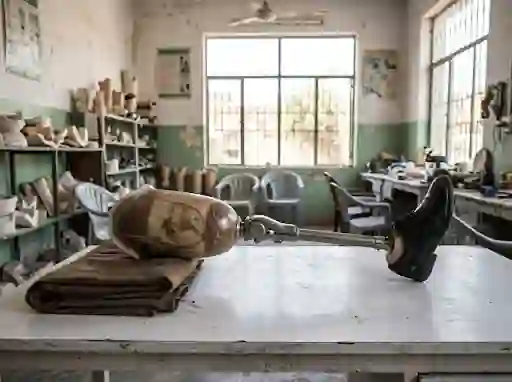
Is it right for you?
What goes into it
The wide end of the stump helps hold the leg on, but it also has to pass into the socket.
| Part | Local build | Imported build | What it changes for you |
|---|---|---|---|
| Socket | Laminated socket with a removable inner liner to pass the wide end | Flexible inner socket or silicone liner with a soft end pad | Getting the leg on, and comfort on the end |
| Suspension | The wide end itself holds the socket on | Liner with pin lock or seal | Security without belts |
| Knee | Outside hinges or a basic polycentric knee | Compact polycentric or hydraulic polycentric knee | Knee position when sitting, stability and swing |
| Foot | SACH or local dynamic foot | Carbon fibre foot | Push-off and distance |
| Cover | Plain finish | Foam cover shaped to the other leg | Look under clothes |
Cost in 2026
Rs 170,000 to 2,500,000+open top end: imported parts
Laminated socket with a removable inner liner, a basic knee and a SACH or local foot. Solid and dependable for first legs.
An imported compact polycentric knee and an imported dynamic foot, with a better liner for comfort on the end.
Hydraulic polycentric knees made for knee disarticulation, premium liners and feet. Microprocessor options cost more.
Indicative ranges. A firm figure comes in writing after the free assessment and does not change without your agreement. Full cost guide.
Your visits
We test how much weight the end takes, check the skin and the hip, and talk about your goals.
An impression that captures the wide end and the narrower part above it.
A clear socket shows whether it passes over the end comfortably and holds firmly.
The knee is set as low and as close to the other side as the parts allow.
Balance, steps, stairs and sitting, usually fewer sessions than above knee.
Coming from out of town? Tell us your dates and we will plan the visits close together.
After an above knee amputation the cut thigh bone cannot take weight on its end, so the socket supports you through the sitting bone. After a knee disarticulation the rounded end of the thigh bone, covered by the original tissue, usually can. Standing feels more natural, you feel the ground better through the stump, and the long thigh gives your hip muscles a strong lever to control the knee.
The wide end also helps keep the leg on. In many cases no belt or suction is needed, which is a relief in hot weather.
Because your thigh bone is full length, the artificial knee has to sit below it. With an ordinary knee joint this makes the artificial thigh longer and the lower leg shorter. When you sit, the artificial knee sticks out further than the other knee.
Compact four-bar polycentric knees are made for this level. Their pivot sits higher than it looks, they fold the lower leg back under the knee when you sit, and they keep the difference small. Most people stop noticing it once dressed.
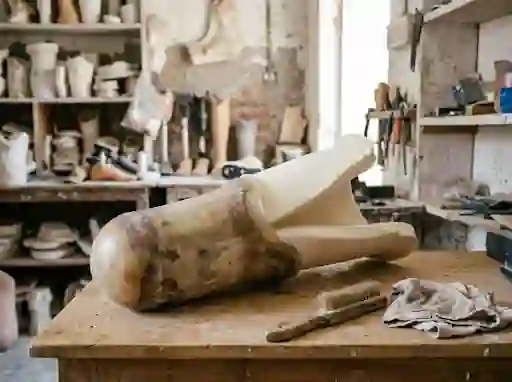
Most through-knee users learn to walk faster than above knee users because the stump is strong and gives good feedback. Floor sitting is easier when the leg is off; with it on, the long thigh makes cross-legged sitting awkward. For namaz, many users stand with the leg on and use a chair for sajda.
In hot months, the end of the stump can sweat inside the liner. Dry it at midday and check the skin at night, especially over the bony end.
If the level of amputation is still being discussed, you are welcome to call us. We can explain what each level means for the leg later and for walking. The medical decision always stays with your surgeon, and we will fit the best leg we can for whichever level is chosen.
Travelling to us?
Tell us your city or country and your travel dates when you call. We plan the visits as close together as the stump allows, so most patients can finish the casting, test socket and fitting in one stay, whether they come from Quetta or fly in from Dubai, with a shorter trip later for adjustments if needed.
Questions
Often it is easier to stand and balance on, because the end of the thigh bone can take weight and the full thigh muscles remain. The trade-off is a longer thigh, which makes the knee line uneven when sitting. Your surgeon decides the level; we fit the leg to whatever was done.
Because the socket goes over the end of your full-length thigh bone, the artificial knee ends up below it. Compact four-bar knees reduce the difference, and most people stop noticing it once dressed.
Usually yes after a knee disarticulation, once it has healed. We test it gently at the assessment. If the end is tender, the socket is shaped to take weight higher up instead.
From Rs 170,000 for a local build to Rs 2,500,000 or more with imported knees made for this level. The knee is most of the difference.
Related
Replaces the knee too. The knee joint you choose shapes how you walk.
Read moreFour-bar knees: stable when standing, short when swinging.
Read moreThe part you feel all day, cast and test-fitted to your stump.
Read moreWalking lessons on the new leg, from balance to stairs.
Read moreWe import and fit parts from Ottobock, Össur, Blatchford, Proteor, Fillauer and other makers to order, and we are independent of all of them. Brands we fit.
Fill this in and WhatsApp opens with your message ready to send. Add a photo of the stump in the chat if you can; it tells us more than any description.
Prefer to talk? Call +92 337 841 4002 at any hour.