Entry running blade Rs 450,000 to 900,000
A recreational running blade with a sport socket, for fitness running and jogging.
- Assessment
- Sport socket
- Run training
Sport prosthesis
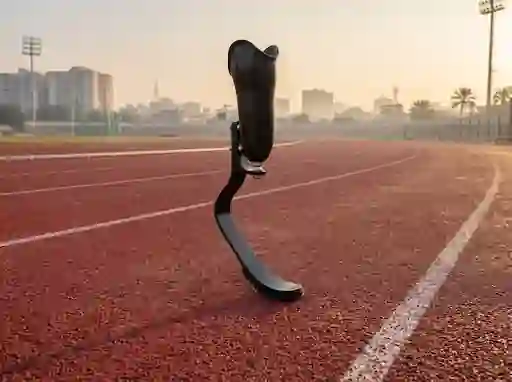
A running blade is a curved carbon spring with no heel, built to return energy with every stride when you run on your toes. It is not for walking around the house; it is a second leg for training, sport and competition, with a socket made to stay put at speed.
Reviewed by Ummad Shafique Mughal, Consultant Orthotist and Prosthetist. Updated October 2026.
In short
The short answer
Running blades are J-shaped or C-shaped carbon springs that attach to a sport socket. The blade compresses as your weight lands and springs back as you push off, which is why sprinters and distance runners use them. Because there is no heel, they are made for running on the forefoot, not for standing or everyday walking. Well-known blades include the Össur Cheetah and Flex-Run and the Ottobock 1E90 Sprinter.
A running leg with a blade and a sport socket costs about Rs 450,000 to 2,500,000 or more.
Is it right for you?
What goes into it
Everything is built to stay put and return energy at speed.
| Part | What we use | Why |
|---|---|---|
| Socket | Close-fitting sport socket | Stays put at speed |
| Suspension | Seal-in liner, vacuum, or pin with a sleeve | No movement while running |
| Blade | Carbon blade chosen by weight, sport and level | Energy return with every stride |
| Knee (above knee) | Sport knee made for running | Safe, fast swing |
| Sole | Spiked or rubber sole | Grip on track or road |
Cost in 2026
Rs 450,000 to 2,500,000+open top end: imported parts
A recreational running blade with a sport socket, for fitness running and jogging.
Imported performance blades for regular training and competition.
A sport knee with a running blade and a secure socket.
Indicative ranges. A firm figure comes in writing after the free assessment and does not change without your agreement. Full cost guide.
Your visits
Your sport, goals and current leg.
A sport socket, cast and test-fitted.
Stiffness chosen for your weight and sport.
Alignment set for running, not walking.
Drills and a gradual build-up of distance and speed.
Coming from out of town? Tell us your dates and we will plan the visits close together.
A walking foot is built to land on the heel and roll over the toes. A running blade is built to land on the forefoot and bounce. Its curve stores energy as you load it and gives it back as you leave the ground. Standing still on a blade feels like standing on a spring, which is why runners change to their everyday leg once training is over.
A good walking pattern on your everyday leg comes first. Then running starts with drills: hopping, skipping and short, easy jogs on a flat surface. Distance and speed build gradually over weeks, giving the skin of the stump time to toughen. Most runners begin with steady jogging long before any sprinting.
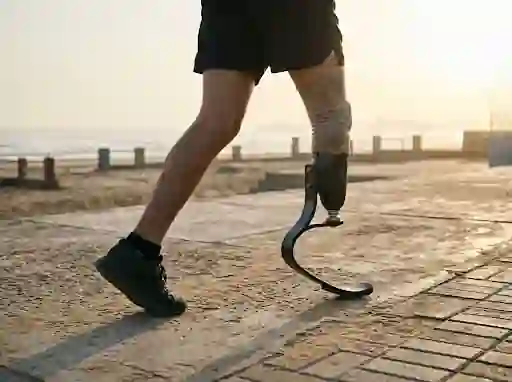
Blades are made for running in straight lines and gentle curves. For cricket, football and sports with lots of turning, many users do better with a strong everyday leg and a dynamic carbon foot, or a sport foot with a heel. Tell us your sport and we will suggest the right set-up.
Check the carbon for cracks or splits before every session, replace the sole pad when it wears, and rinse off sand after beach runs. Running loads the stump heavily, so check the skin after every session and stop if you see redness that does not fade or any broken skin.
Travelling to us?
Tell us your city or country and your travel dates when you call. We plan the visits as close together as the stump allows, so most patients can finish the casting, test socket and fitting in one stay, whether they come from Quetta or fly in from Dubai, with a shorter trip later for adjustments if needed.
Questions
Not comfortably or safely for everyday life. Blades have no heel and are designed for running on the forefoot. Most runners keep their everyday leg for walking and change to the blade for training.
A complete running leg costs about Rs 450,000 to 2,500,000 or more, depending on the blade, the socket and, above the knee, the sport knee.
Yes. Junior blades exist for growing children. Because children grow, we plan socket changes, and the blade category changes with weight.
Yes. Running on a blade uses a different technique. We set the alignment and show you drills, and a gradual build-up protects the stump and joints.
Related
The most common leg we fit: your own knee bends, the socket and foot do the rest.
Read moreSpringy feet that store energy and give a stronger push-off.
Read moreLegs that grow with your child, with regular checks and quick changes.
Read moreWalking lessons on the new leg, from balance to stairs.
Read moreWe import running blades from Össur and Ottobock to order, and we are independent of both. Brands we fit.
Fill this in and WhatsApp opens with your message ready to send. Add a photo of the stump in the chat if you can; it tells us more than any description.
Prefer to talk? Call +92 337 841 4002 at any hour.