With a new leg Included
Training at fitting and follow-ups is part of every leg we make.
- Bars and stairs
- Home exercises
- Family coaching
Learning to walk again
A well-made leg is only half the job; the other half is learning to trust it and walk on it well. Training starts the day the leg is fitted and continues at follow-ups, so bad habits never set in and you walk as naturally as your level allows.
Reviewed by Ummad Shafique Mughal, Consultant Orthotist and Prosthetist. Updated October 2026.
In short
The short answer
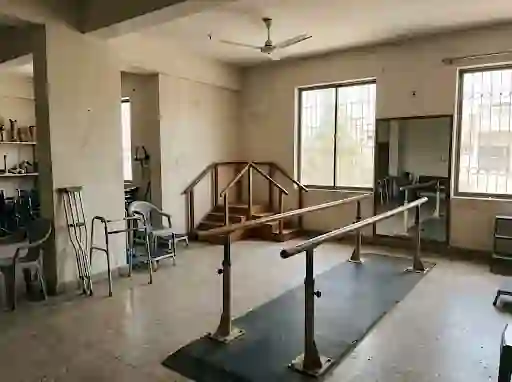
Gait training means learning to walk with your artificial leg: standing with weight on it, moving it in time with your body, and handling everyday situations such as chairs, stairs and uneven ground. We teach between parallel bars first, then with a frame, crutches or a stick, then without support where that is safe. We also watch your walk for limping, swinging or leaning, which usually point to something we can adjust in the leg.
Training is part of every leg we make.
Who it helps
Stages
Each stage builds on the last. Nobody moves on until they are safe.
| Stage | What you practise | Typical support |
|---|---|---|
| Standing | Weight shifting and balance | Parallel bars |
| First steps | Stepping in rhythm, turning | Bars, then a frame |
| Daily skills | Chairs, toilet, car, the floor | Frame or sticks |
| Outdoors | Kerbs, slopes, stairs and crowds | A stick, or none |
| Fine tuning | Smoothing the walk and speed | None, with feedback |
Cost
Training is part of the leg, not an extra.
Training at fitting and follow-ups is part of every leg we make.
A new knee or foot comes with the training to use it well.
For users who want to improve their walk; we tell you any cost before booking.
Indicative ranges. A firm figure comes in writing after the free assessment and does not change without your agreement. Full cost guide.
Your visits
Weight shifting and balance between the bars.
Stepping in rhythm, then turning.
Chairs, toilets, cars and the floor.
Kerbs, slopes, stairs and crowds.
Smoothing the walk at follow-ups.
Coming from out of town? Tell us your dates and we will plan the visits close together.
Without training, most new users protect the artificial leg: they put less weight on it, take a short step with the good leg and lean or swing to compensate. Those habits set in within weeks and cause back, hip and knee pain later. A few focused sessions at the start teach the body to trust the leg, and the walk that results is safer, faster and less tiring.
We show you which exercises suit you and how many to do. If anything hurts, stop and tell us at the next visit.
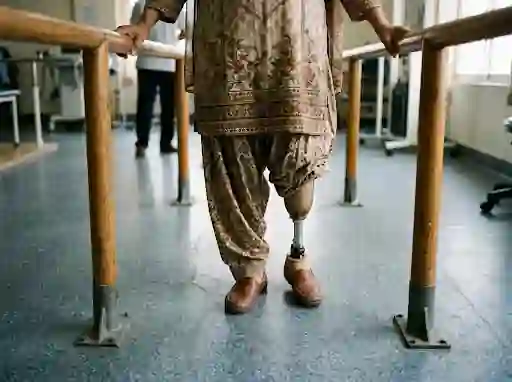
For stairs, most users learn the rule "up with the good leg, down with the artificial leg", one step at a time, holding a rail. On steep slopes, walking slightly sideways can feel safer. Kerbs are taken like a single stair. With practice and the right knee or foot, many users progress to more natural patterns.
Everyone falls once in a while. We teach you how to fall more safely, turning to land on your side, and how to get up from the floor using a chair or a step. Knowing you can get up makes you less afraid of falling, which in turn makes you steadier.
Families often help too much: holding an arm on every step, or doing tasks the user should practise. Watch at least one session so you know when to help and when to stand back, encourage short daily practice, and keep the floors clear of rugs and clutter.
Travelling to us?
Tell us your city or country and your travel dates when you call. We plan the visits as close together as the stump allows, so most patients can finish the casting, test socket and fitting in one stay, whether they come from Quetta or fly in from Dubai, with a shorter trip later for adjustments if needed.
Questions
Yes. Training at fitting and follow-ups is part of every leg we make.
It varies. Many below knee users walk without support within weeks of daily practice. Above knee users and older patients often keep a stick outdoors for longer, and that is fine.
A limp can come from the alignment of the leg, the socket, weak hip muscles or habit. We look at all four and fix what we can in the leg first.
Yes. We encourage it, so they know how to help at home without over-helping.
Related
The most common leg we fit: your own knee bends, the socket and foot do the rest.
Read moreReplaces the knee too. The knee joint you choose shapes how you walk.
Read moreFine-tuning a leg that causes pain, a limp or a sore back.
Read moreLight, safe legs for standing, transfers and walking at home.
Read moreWe import and fit parts from Ottobock, Össur, Blatchford, Proteor, Fillauer and other makers to order, and we are independent of all of them. Brands we fit.
Fill this in and WhatsApp opens with your message ready to send. Add a photo of the stump in the chat if you can; it tells us more than any description.
Prefer to talk? Call +92 337 841 4002 at any hour.